

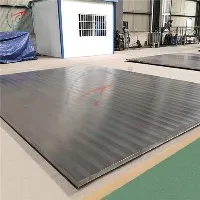

1 Products Description
C11000 copper clad steel plate has been widely used because it has both the special properties of the clad material and the strength and stiffness of the base material. The C11000 copper clad steel plate produced by combining carbon steel as the base layer and copper clad layer is now receiving more and more attention. This composite plate gives full play to the advantages of the two materials, which not only has the corrosion resistance, wear resistance, high conductivity, and thermal conductivity of copper, but also has the advantages of high strength and low price of carbon steel, so the copper/steel composite plate has great application prospects. It is mainly used in the fields of military industry, electronics, cooking utensils and architectural decoration. Other fields include heat exchanger, synchronizer drop ring, reducer turbine, bearing bush, etc. in the automotive industry, and electrodes in the metallurgical industry.


2 Products Features
At present, copper/steel composite plates are mainly produced by explosive bonding, explosive+rolling bonding, and diffusion bonding. The composite plates used in this paper are produced by the explosion. The production process of the explosive composite method is as follows: first, put the composite plate on the base plate, and use a gap pad in the middle to maintain a certain distance. Place a layer of explosives and detonators on the composite plate. When the explosives are detonated by detonators, the explosives will spread forward on the composite plate at the detonation speed. The huge kinetic energy generated by the detonation wave and explosive rapid expansion is transferred to the clad plate, which drives the clad plate to move toward the substrate at high speed. The clad plate and the substrate collide successively at the contact point, resulting in strong plastic deformation. In this process, most of the kinetic energy is converted into heat energy, and a large amount of heat energy melts the metal under the condition of nearly adiabatic, and realizes the welding combination under the action of high pressure. Figure 1 is the installation diagram of the explosive welding process.

3Effect of annealing on microstructure
The copper/steel composite plate will undergo three different stages of recovery, recrystallization, and grain growth during annealing, which can be used to change the structure of the metal to obtain reliable properties. Different heat treatment temperatures will affect the microstructure of copper/steel composite plate, but the microstructure of Q235B and the microstructure of copper at temperatures lower than 700 ℃ have little change, indicating that recovery occurs at this temperature. Figure 7 shows the microstructure of copper when annealed at 750 and 800 ℃. It can be seen that the fully grown recrystallized structure is formed at 750 ℃. It can be determined that the undistorted new grains will be regenerated in the deformed matrix above 750 ℃, and the grain growth will occur with the increase of temperature. Therefore, it can be determined that the annealing temperature of about 700 ℃ is the critical temperature for recovery and recrystallization of copper/steel composite plate.
4 SEM and EDS analysis
Due to the diffusion of elements during explosive welding and the heat preservation effect of annealing treatment, element diffusion will occur at the bonding interface, mainly the diffusion of Fe and Cu. On the one hand, element diffusion is conducive to the improvement of the bonding interface strength; On the other hand, metal compounds may be produced to reduce the bonding strength. Figure 8 shows the diffusion of Cu and Fe elements at the bonding interface of copper/steel composite plate and the thickness of the interface diffusion layer under different annealing temperatures. It can be seen that with the increase of annealing temperature, the thickness of the alloy element diffusion layer becomes wider. However, no compound is produced and the thickness layer does not change much under the heat treatment, 650 ℃ and 700 ℃ (the curves are not given at the two temperatures limited to the length), which are 1.5, 1.8, and 2.0 respectively μ m. 700 ℃ annealing is suitable. When the temperature is higher than 750 ℃, the thickness of the diffusion layer obviously widens and steps appear, indicating that compounds are produced on the interface, and the diffusion layer thickens sharply at 800 ℃, and the melting layer also thickens. The above conclusion can also be drawn by comparing the thickness of the melting layer at the wave crest in Figure 9.
Cool tags: c11000 copper clad steel plate, China, manufacturers, suppliers, factory, customized, buy, price, quality, quotation, pricelist, in stock, SECHION စနစ်အတွက်ပြွန်စာရွက်, အမြောက်အများအတွက် clad bar ကိုပေးသွင်း, Clad သံမဏိပြားဘား, နီကယ် Clad ဘား, Clad ဦး ခေါင်းပြွန်စာရွက်, Clad Prodosion Protection ကိုကာကွယ်စောင့်ရှောက်ရေးအတွက်ဘား


